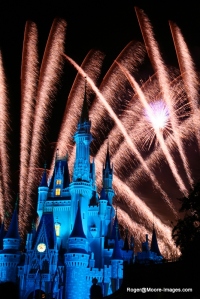
Independence Day Photos & Suggestions

I begin this weekend without any major shooting events. Considering I’m living in a country that was on the losing end of this American holiday, there aren’t many celebrations to be had. However, I received many emails on shooting 4thof July fireworks celebrations. Therefore, I wanted to provide my input.

Historically, the camera settings were the “trickiest” part of photographing fireworks. However, many newer models come with an actual “Fireworks” setting. Therefore, much of the mystery is removed.

Great fireworks images contain more than the brilliant and colorful bursts in the night sky. They provide a beautiful skyline composition or other landmarks that provide a sense of place to the image.

However, before we begin with the composition, some basic gear is necessary. Any sharp fireworks image requires a tripod. You can obtain an inexpensive one, under $30 dollars from local electronic or retail stores. They provide stability and provide sharp images difficult to obtain otherwise. Next, use a remote trigger. This allows the user to activate the shutter without touching the camera. Even the slight vibration from pressing the camera button creates enough shake to blur the images slightly. If that is not available, put the camera on a two-second delay if possible. That requires great timing considering you must anticipate when the bursts will appear.

Secondly, compose the shot to include buildings or a familiar image. These elements disclose your location and show how large the displays were. They also help to focus the camera prior to the fireworks.

Some cameras do not have a fireworks setting. Therefore, manual exposure settings are necessary. If you have a Point & Shoot (P&S) without a fireworks setting, I recommend you put the camera on the “Shutter Priority” setting (i.e., S or Sv) between three to five seconds. This value depends on the length of the fireworks burst. I typically try to keep the shutter open long enough to get a burst from its lift-off to the burst in the sky. You may have to change this setting during the fireworks. Therefore, understand this setting so you can make the necessary changes quickly.

Taking photos of fireworks at night is difficult for the camera’s auto focusing mechanism whether it’s a P&S or SLR. The camera is attempting to photograph a moving object at night that is visible for only a few seconds. Therefore, it is highly recommended that you turn off the Auto focus setting—if possible. This is another reason why landscapes are helpful. They allow you to focus on the building manually. Therefore, when the fireworks begin, the camera is set to sharply capture the images.

SLR USERS – I recommend the aperture set to F/8 to F/16. This will allow you to obtain enough depth of focus even if the fireworks are not allows on the same focus plane. Also, set the manual focus to infinity unless you’re very close to the action. P&S users do not typically have to worry about their aperture since the smaller sensor size provides very adequate depth of focus.

Lastly, I included fireworks shots from my first attempt. They’re only the burst. You do not see the lift-off. Also, there are no recognizable landmarks. They do not provide any scale or sense or location that I discussed earlier. The images lack interest. However, I linked my other images and you can immediately tell where I was and how big the celebration was.

I Included a link to some additional fireworks images. I hope you like them.

God Bless & Keep Shootin’

-Roger

IMG_018791

Share
Lessons in Preparation and Perseverance

“Don’t pack up your camera until you’ve left the location” – Joe McNally, “The Moment It Clicks”

These are the simple yet, profound words from the esteemed photographer who has worked in the photography business for a few decades.  He made this point to illustrate that once you’re done photographing your initial subject, keep your camera available to capture images that may develop as your initial work concludes.  You may discover opportunities initially unforeseen.

However, we could also say the prelude to this advise is equally true.  

“Unpack your camera before you arrive at the location.”

As the family and I left the hotel Saturday evening, I debated whether or not to remove my camera from the bag or keep it packed until I arrived at “the location”.  Although there was no set location in mind, I thought taking it out the bag at the hotel was too early.  No sooner had I decided to keep it tucked away, we began to see all manner of individuals dressed in costumes and outrageous attire.  Several photographic opportunities appearing and disappearing before my eyes while my camera remained in the bag.  All I could do was shake my head in disbelief as the opportunites missed based on my decision passed me.  

Now, you may think, “Why couldn’t you just pull out the camera?”  However, I hadn’t used it since earlier in the day.  Therefore, I had to change the settings to compensate for the nighttime environment.  I also had to mount the external flash.  All these adjustments require a minute or so to accomplish.  Unfortunately, opportunities that appear quickly, disappear just as fast.

I read many articles, books, etc. that emphasized the need to be prepared for those unexpected shots.  As photographers, we’re so focused on the correct composition, exposure, lighting, etc.  However, just having the camera ready to take a shot will suffice.

I had a slight moment of redemption when several men wearing tropical shirts, lei, and accompanying party hats walked towards me.  Prior to seeing them, I removed my camera because I realized there were many sights to see this evening.  However, not fully prepared to shoot photos, my settings were not correct.  Nevertheless, I knew I wanted something instead of nothing so I took the shot.  The result was blurry and not the most photographically-correct image.  However, it is infinitely better than a mental image that would fade over time.

Therefore, as I already knew to keep the camera out when I’m done with an initial shoot, I’ll prepare it for work as soon as I leave my home…or hotel.

Secondly, a lesson in perseverance paid big dividends.  I wrote about the “Magic Hour” also known as twilight in my previous blogs–check it out here.  This is the time when the sun has set and the sky turns a cobalt blue.  It happens before sunrise and after sunset.  However, this period only lasts for 10-20 minutes–depending on the time of year.

Deborah and Jordyn went to a popular restaurant to eat.  I wanted to join them.  However, we went to eat just as twilight was beginning and I wanted to photograph the town of York during twilight–taking great shots require a sacrifice of sleep or dinner at times.  I walked to the bridge, set up my camera and began shooting.  Unfortunately, the photos did not materialize the way I visualized it.  Nevertheless, I kept shooting as I hoped to salvage something from this setup.

I eventually packed up, not wanting to waste more time at this site.  A bit disappointed that I missed dinner with the girls and nothing to show for it, I walked towards the restaurant.  As I turned the corner, I  noticed that Clifford’s Tower was lit at night.  I remembered seeing the lights surround the tower earlier that day.  However, I forgot about them.  As I looked at the tower glowing above the city, I noticed the twilight sky had not turned black.  I quickly setup my tripod and camera and began shooting.  When I was done, I left with a feeling of sincere fulfillment.  I did not capture what I intended.  Yet, I captured more than I imagined.

The lesson here is similar to the phrase, “Reach for the moon and if you miss you’re still amongst the stars”.  There are other sayings, scriptures, anecdotes that are equally applicable to this story.  The bottom line is I made an effort and put myself in position to achieve something.  Although my initial goal was not accomplished, I was positioned to take advantage of the other opportunity available to me.

You do not need to be a photographer to value the importance of preparation and perseverance in any aspect of life.  Therefore, always be ready and run this race with patience and determination.

      Side note:  If you look closely at the picture of Clifford’s Tower, you’ll see a couple standing in the street taking a picture.  You can see the bright light from their camera’s LCD screen which is the tower–just a little detail I found interesting.

Keep Shooting and God Bless.

-Roger

[polldaddy poll=1649138]

Share